Post
Siu Mai Secrets: Everything You Need to Know About This Beloved Dim Sum Staple
May
Siu Mai Secrets: Everything You Need to Know About This Beloved Dim Sum Staple
If Har Gow is the undisputed king of dim sum, then Siu Mai is undoubtedly its beloved queen. Open-topped, generously filled, and bursting with the combined rich, savory goodness of pork and shrimp, Siu Mai is one of the most immediately recognizable and universally adored dishes in the entire spectrum of Chinese cuisine. Its distinctive shape — a cylindrical basket of thin, golden wonton wrapper holding a mountain of savory, juicy filling — makes it instantly identifiable on any dim sum cart from Hong Kong to New York City to London’s Chinatown. Unlike the delicate, translucent, almost fragile Har Gow, Siu Mai is bold, rustic, hearty, and deeply satisfying, offering a completely different but equally rewarding eating experience. Where Har Gow is subtle and refined, Siu Mai is robust and comforting. Together, they form the perfect yin and yang of the dim sum experience, and no proper dim sum meal is complete without both. The beauty of Siu Mai lies in its generosity — the open top allows the diner to see exactly what they are getting, and the filling is always plentiful. There is nothing hidden or mysterious about Siu Mai; it is straightforward, honest, and delicious.
What Is Siu Mai?
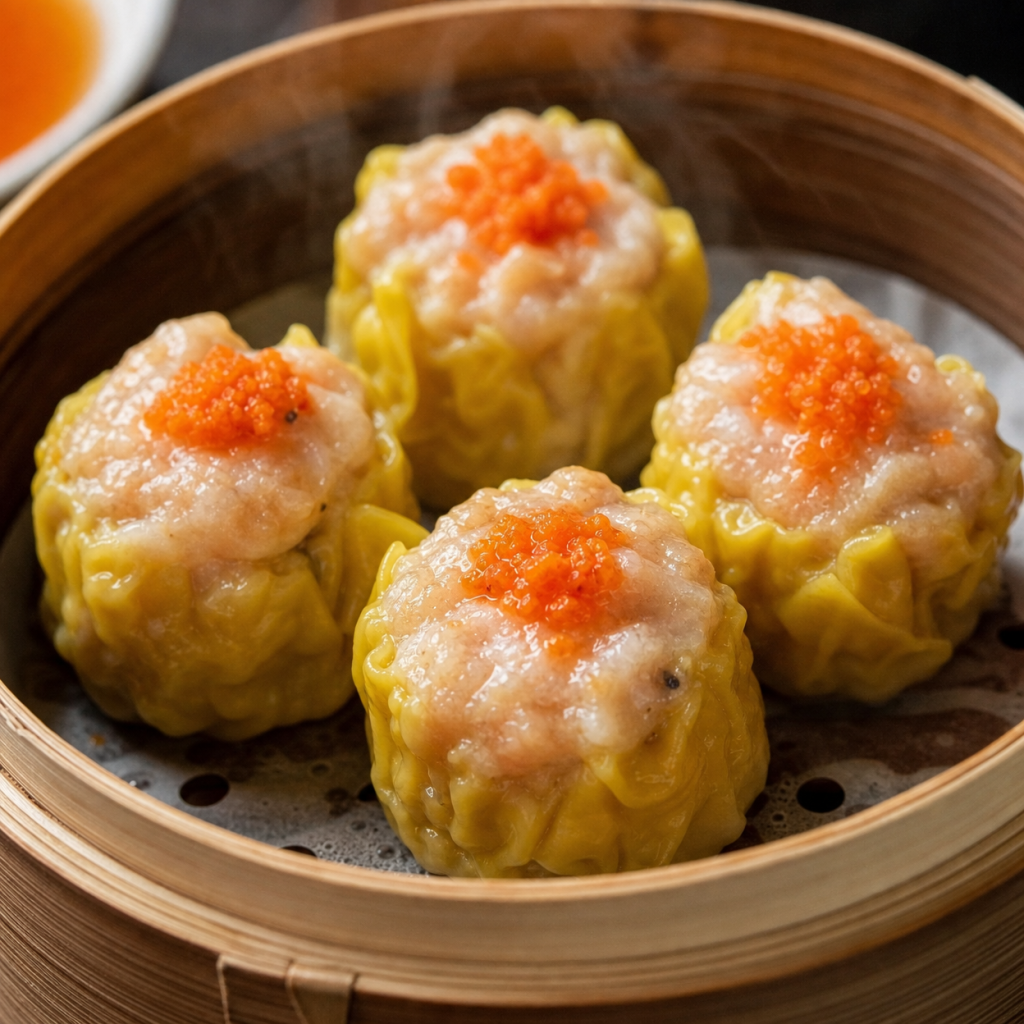
Siu Mai (燒賣) is a type of open-topped steamed dumpling that features a thin wonton-style wrapper carefully gathered around a filling of ground pork, whole or halved shrimp, shiitake mushrooms, and water chestnuts. Unlike closed dumplings like Har Gow or potstickers, the Siu Mai wrapper is deliberately left open at the top, exposing the colorful, attractive filling and allowing for a decorative garnish — traditionally a tiny orange dot of fish roe or a single vibrant green pea placed right in the center. This open-top design is not merely aesthetic; it also allows steam to penetrate the filling more directly during cooking, ensuring that the center cooks through completely and evenly. The name Siu Mai (also romanized as Shao Mai or Shumai) translates roughly to “cook and sell” in Cantonese, a direct reference to its humble origins as a popular, portable street food sold by vendors. The dish is sold throughout China in various regional forms, each with its own local characteristics, but the Cantonese version — plump, juicy, and precisely crafted — remains the most internationally celebrated and widely imitated.
The Historical Journey of Siu Mai
Siu Mai has a remarkably long and fascinating history that significantly predates its association with dim sum culture. Historical records suggest that some form of Siu Mai existed as early as the Yuan Dynasty, when it was consumed along the ancient Silk Road in what is now Inner Mongolia. The original versions were likely much simpler and rougher — coarse wheat wrappers filled with whatever meat was available that day — and were eaten as a portable, filling, nutritious meal for travelers and laborers rather than a delicate teahouse snack for the wealthy. As the dish slowly migrated southward over centuries and was gradually adopted into refined Cantonese cooking, it underwent a complete transformation. The rustic meat parcel became a refined, elegant, bite-sized creation. Cantonese chefs refined the wrapper to be thin and delicate, introduced shrimp as a beautiful counterpoint to the rich pork, and developed the signature open-top presentation that distinguishes Cantonese Siu Mai from its northern cousins forever. By the late Qing Dynasty, Siu Mai had become a fixture of every respectable dim sum house in Guangdong and Hong Kong.
Inside the Filling: What Makes Siu Mai So Irresistible
The brilliance of Siu Mai lies in the masterful construction of its filling, which carefully balances multiple flavors and textures in a single bite-sized package. The base of the filling is ground pork with a medium fat content — typically around 20 to 30 percent fat. This specific fat ratio is absolutely crucial: too lean and the filling becomes dry, crumbly, and disappointing; too fatty and it becomes unpleasantly greasy and heavy. The pork is seasoned with a complex mixture of soy sauce, oyster sauce, Shaoxing rice wine, white pepper, sugar, sesame oil, and cornstarch. The cornstarch serves a beautiful dual purpose — it helps bind the filling together and gives the cooked pork a slightly elastic, bouncy texture that is highly characteristic of well-made dim sum. This bouncy texture is prized in Cantonese cooking and is a sign of quality.
Unlike the finely chopped shrimp found in some inferior, budget-conscious fillings, quality Siu Mai features large, whole or halved shrimp nestled prominently into the pork mixture. These shrimp are typically seasoned separately with just salt and a touch of sesame oil before being incorporated. When bitten into, the shrimp deliver a satisfying, audible snap and a burst of sweet, clean, oceanic seafood flavor that contrasts beautifully with the rich, savory, fatty pork. Finely diced dried shiitake mushrooms and water chestnuts are the textural additions that elevate Siu Mai from a simple pork dumpling to something genuinely complex and interesting. The mushrooms contribute a deep, earthy, umami flavor that enriches the entire filling, while the water chestnuts provide small, crisp pockets of pleasant crunch that punctuate every single bite with delightful textural contrast. Some modern versions add crab meat or truffle, but the classic combination remains the most beloved.
The Art of Assembling Siu Mai
While Siu Mai does not require the same intricate, time-consuming pleating technique as Har Gow, assembling it correctly is its own form of craft that demands practice and a gentle touch. The filling is placed in the center of a square wonton wrapper and gently gathered up by the chef’s thumb and index finger, creating a neat, tall cylinder shape. The wrapper is pressed against the filling firmly at the sides to create straight, vertical walls, while the top remains deliberately open to showcase the beautiful filling within. The base of the dumpling is patted flat against the work surface so it can stand upright during steaming without tipping over. The garnish is the finishing touch — a small dot of bright orange tobiko (flying fish roe) or masago (capelin roe) placed precisely at the center of the exposed filling, or alternatively a single vibrant green pea. This tiny addition is primarily aesthetic, but it transforms the humble dumpling into something that looks as refined, appetizing, and professional as it tastes.
Steaming and Serving Siu Mai
Siu Mai is traditionally steamed in bamboo steamers for approximately eight to ten minutes over vigorously boiling water. The steaming must be done at consistently high heat to ensure the filling cooks through completely and the wrapper becomes tender without becoming waterlogged or sticky. The finished Siu Mai should be plump and glistening, with a slightly firm exterior that yields to reveal a juicy, flavorful, aromatic interior. At the table, Siu Mai is typically served with a small bowl of light soy sauce mixed with a touch of fresh ginger juice, or with Chinese mustard for those who enjoy assertive, sinus-clearing heat. Some restaurants serve Siu Mai alongside chili oil or a sweet soy dipping sauce. The traditional way to eat Siu Mai is to pop the whole dumpling into your mouth in one generous bite, experiencing the full, harmonious combination of pork, shrimp, mushroom, and wrapper simultaneously. This is comfort food at its finest.
Why Siu Mai Remains a Dim Sum Essential
Whether you enjoy Siu Mai at a traditional Cantonese teahouse or a modern, upscale dim sum restaurant, this beloved dumpling never fails to satisfy. Its perfect combination of juicy pork, sweet shrimp, earthy mushroom, and delicate wrapper is one of the most harmonious flavor profiles in all of Chinese cuisine — a lasting testament to the brilliance of Cantonese dim sum culture and the enduring appeal of food that is made with genuine care, skill, and respect for tradition. For countless dim sum lovers around the world, a meal without Siu Mai feels incomplete, and that is the highest compliment any dish can receive.
