Post
Best Dan Tat Egg Tarts 2026: A Deep Dive into China’s Most Beloved Pastry Dessert
May
Dan Tat Egg Tarts: A Deep Dive into China’s Most Beloved Pastry Dessert
Bite into a freshly baked Chinese egg tart and you will understand immediately why this unassuming, humble little pastry has conquered hearts from Hong Kong to Macau to the Chinatowns of every major city in the world.
The outer shell either shatters delicately or yields softly depending on whether it is the crumbly shortcrust or the flaky, buttery puff pastry, and the custard within — smooth, silky, wobbling gently, and perfectly set — delivers a clean, gentle sweetness that is deeply satisfying without being cloying or overwhelming.
It is one of the great pastry achievements of Cantonese cuisine, and its fascinating story is one of cultural fusion, colonial history, and culinary ingenuity that spans centuries and continents. The egg tart is proof that sometimes the simplest things in life are also the most beautiful and enduring. Whether enjoyed with a cup of strong Hong Kong-style milk tea in a cha chaan teng or as a dessert after a lavish dim sum feast, the dan tat never fails to bring a smile.
What Is a Dan Tat?
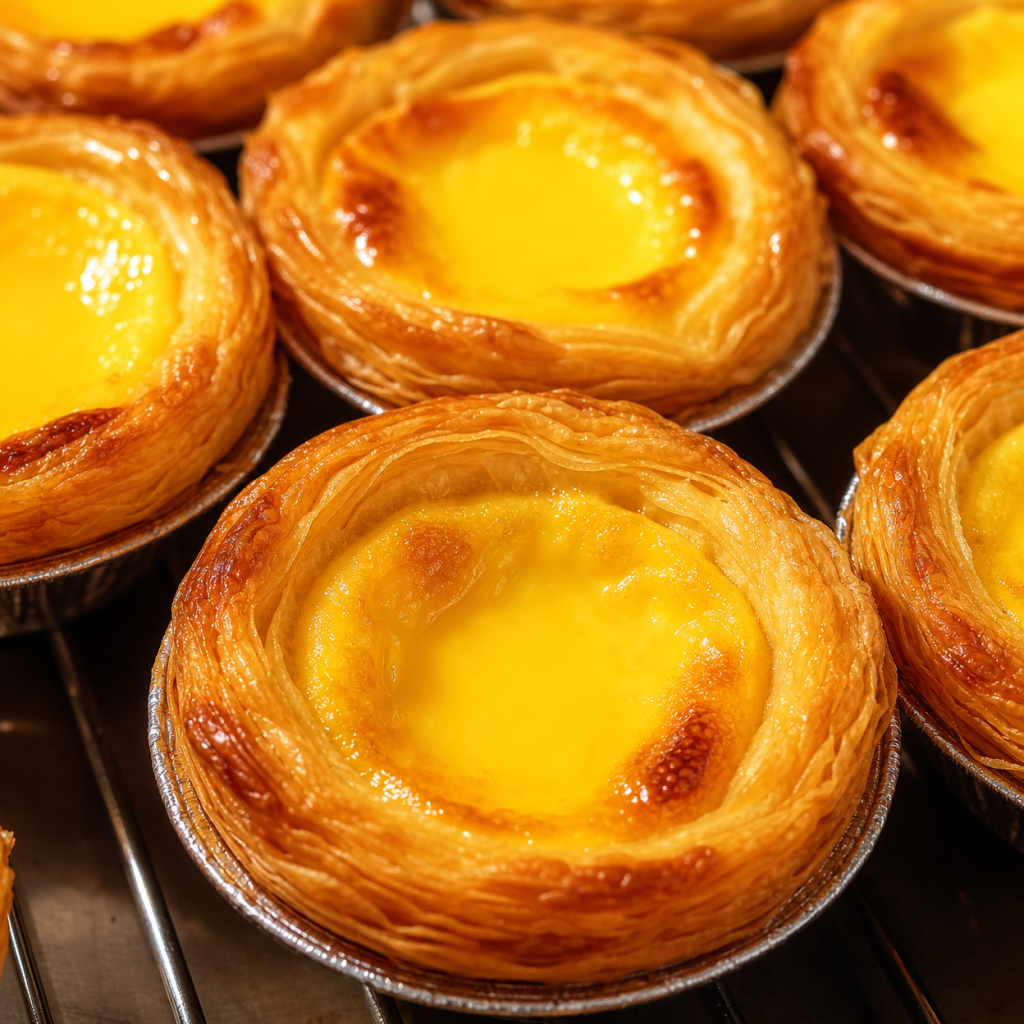
Dan Tat (蛋撻), literally “egg tart,” is a small, individual-sized pastry consisting of a tart shell filled with a smooth, slightly wobbly, pale yellow egg custard that is baked until just set and still quivering slightly. The custard is made from simple, humble ingredients — fresh eggs, sugar, evaporated milk or cream, vanilla, and sometimes a touch of sweetened condensed milk — creating a flavor that is sweet, lightly eggy, and gently, pleasantly aromatic.
The tart shells come in two main, distinct varieties: a crumbly, cookie-like shortcrust pastry and a laminated puff pastry shell with many flaky, buttery layers that shatter delicately with each bite. Both versions have passionate, devoted devotees who will argue endlessly and happily about which is superior. The shortcrust version is more common in Hong Kong-style bakeries, while the flaky version is more associated with Macau and Portuguese influence. Both are wonderful, and trying both is highly recommended.
The History: A Tale of Two Cultures
The egg tart’s fascinating origin is a beautiful story of cultural exchange between Chinese and Portuguese culinary traditions. The Portuguese pastéis de nata — a custard tart with a caramelized, slightly blistered, almost burnt top — was brought to Macau during the period of Portuguese colonial presence, and local Cantonese bakers were both intrigued and inspired. They adapted the concept masterfully to suit Cantonese tastes, replacing the caramelized, dark custard top with a smooth, pale yellow, unblemished surface, adjusting the sweetness level downward to suit local palates, and creating the characteristic shortcrust version that became the Hong Kong standard.
The Hong Kong-style egg tart spread across Cantonese communities worldwide and became a staple of dim sum restaurants and Chinese bakeries everywhere. Today, the egg tart exists in countless regional and personal variations, but the Hong Kong shortcrust version and the Macau-influenced flaky pastry version remain the two most beloved and iconic forms, each with its own loyal following.
The Shortcrust Egg Tart
The shortcrust version, most commonly found in Hong Kong dim sum restaurants and Chinese bakeries, features a buttery, tender, crumbly shell with a cookie-like texture that holds its beautiful shape perfectly. The pastry is made from simple flour, butter or lard, icing sugar, egg yolks, and a touch of vanilla. The fat is worked carefully into the flour until the mixture resembles fine breadcrumbs, then bound with the eggs to form a soft dough that is rested in the refrigerator before being pressed into individual tart molds.
This resting period is absolutely crucial — it allows the gluten to relax and the fat to solidify, ensuring a tender, non-tough, crumbly crust after baking. The custard filling is prepared by gently whisking together eggs, sugar, evaporated milk, warm water, and vanilla until completely smooth, then straining through a fine sieve to remove any lumps or air bubbles. This straining step is absolutely critical to achieving the characteristic mirror-smooth, unblemished surface of a well-made egg tart.
The Flaky Pastry Egg Tart
The flaky pastry version, associated with Macau and certain Hong Kong establishments, uses a laminated dough created by layering cold butter between sheets of pastry dough and folding repeatedly, similar to the technique used for croissants or puff pastry. This is a labor-intensive process that requires skill and patience. When baked, the pastry puffs and separates into dozens of thin, crispy, buttery, shattering layers that are pure joy to eat.
The flaky version typically has a slightly higher butter content and a more pronounced, indulgent richness than the shortcrust version. Some aficionados are passionate defenders of one version over the other. Shortcrust devotees value the sturdy, cookie-like shell that holds the custard neatly and can be eaten without crumbling all over the plate. Flaky pastry advocates argue that the shattering, buttery, ethereal layers elevate the eating experience to something closer to a Viennese pastry. Both positions have genuine merit, and both produce exceptional, memorable results when executed properly by a skilled baker.
The Perfect Custard: The Heart of the Dan Tat
The custard is where the true art of egg tart making resides. The ideal egg tart custard is pale yellow with an almost mirror-smooth, unblemished, glossy surface, slightly wobbly and quivering in the center when the tray is gently shaken, and completely smooth throughout with no unsightly bubbles or uneven textures. Achieving this perfect result requires precise temperature control during baking — too hot and the custard will bubble aggressively and develop an uneven, unattractive surface; too cool and it will not set properly, remaining a liquid, unappetizing mess.
Professional bakers typically bake egg tarts at a moderate temperature of 160 to 180 degrees Celsius (320 to 350 degrees Fahrenheit), watching carefully and lovingly as the custard slowly transitions from liquid to set. The perfect timing is when the outer edges are fully set but the center still has the slightest, most delicate wobble — carryover heat will complete the cooking as the tarts cool gently on the rack. This takes practice, patience, and a trained, experienced eye.
The Egg Tart in Contemporary Chinese Cuisine
While the traditional egg tart remains enormously popular and beloved, contemporary pastry chefs have explored creative, exciting variations that push the boundaries of the form. Matcha egg tarts, taro egg tarts, pandan egg tarts, and salted caramel egg tarts have all appeared in modern bakeries and dim sum restaurants.
Some ambitious establishments have created miniature egg tarts for upscale tasting menus, while others have developed giant, shareable versions for special occasions. None of these innovations, however appealing or creative, has diminished the appeal of the original, classic version. There is something truly timeless about a small, perfectly made egg tart — its simplicity, its gentleness, its comforting familiarity, and its ability to deliver genuine, reliable satisfaction in just a few delicate bites make it a pastry that transcends fleeting food trends and speaks directly to the pure, uncomplicated pleasure of good food made with care, skill, and love.
The Global Popularity of Dim Sum Culture
Over the past several decades, dim sum has expanded far beyond Southern China and Hong Kong, becoming one of the most internationally recognized forms of Chinese cuisine. Restaurants specializing in dim sum can now be found in major cities all around the world, from New York and Los Angeles to London, Sydney, Singapore, and Toronto. The appeal of dim sum comes from its social nature, incredible variety, and balance of flavors and textures. Diners are encouraged to share multiple dishes, sample different combinations, and enjoy a relaxed dining experience with friends and family. This sense of togetherness has helped dim sum become much more than a meal — it is a cultural experience that people return to repeatedly.
Traditional dim sum meals are usually enjoyed during brunch or lunchtime, often accompanied by hot Chinese tea. The phrase “yum cha,” which means “drink tea” in Cantonese, reflects the deep connection between tea culture and dim sum dining. Different teas are paired with different dishes to balance richness and refresh the palate. Jasmine tea, pu-erh tea, chrysanthemum tea, and oolong tea are among the most popular choices in classic Cantonese teahouses. The tea not only complements the flavors of the food but also encourages conversation and a slower, more enjoyable dining pace.
Why Authentic Preparation Matters
Authentic dim sum preparation requires patience, precision, and years of experience. Skilled chefs spend years perfecting dough textures, fillings, steaming times, seasoning balances, and presentation techniques. Even a seemingly simple dumpling or bun can involve dozens of small details that determine whether the final result is average or exceptional. High-quality ingredients also play a critical role. Fresh seafood, carefully selected meats, premium soy sauce, sesame oil, and aromatic spices all contribute to the depth of flavor that defines authentic Cantonese cooking.
In many respected dim sum restaurants, recipes are passed down through generations of chefs and families. These traditions preserve techniques that have been refined over hundreds of years. While modern restaurants may experiment with fusion ingredients and contemporary presentation styles, the classic foundations of Cantonese dim sum remain timeless. Diners continue to appreciate dishes that honor tradition while delivering comfort, freshness, and carefully balanced flavor profiles.
Dim Sum as a Shared Experience
One of the greatest reasons dim sum remains beloved worldwide is its ability to bring people together. Families gather around round tables, friends share bamboo steamers filled with freshly prepared dishes, and conversations flow naturally throughout the meal. Unlike individual plated dining experiences, dim sum encourages sharing and interaction. Every dish placed at the center of the table becomes part of a collective experience that creates memories as meaningful as the food itself.
Whether enjoyed at a luxurious Hong Kong tea house or a small neighborhood restaurant, classic dim sum dishes continue to represent warmth, hospitality, and culinary craftsmanship. Their enduring popularity proves that carefully prepared comfort food never goes out of style. For food lovers everywhere, exploring authentic dim sum remains one of the most rewarding journeys in the world of Chinese cuisine.
