Post
Best Beef Chow Fun 2026: The Definitive Guide to Cantonese Wok-Fired Noodle Perfection
May
Beef Chow Fun: The Definitive Guide to Cantonese Wok-Fired Noodle Perfection
In the vast and magnificent landscape of Chinese noodle dishes, Beef Chow Fun occupies a position of unique and well-deserved prestige. Unlike delicate noodle soups, which are judged primarily on the quality and depth of their broth, or hand-pulled noodle dishes, which showcase the pasta-maker’s physical artistry and strength, Beef Chow Fun is a dish defined entirely by the mastery of one specific technique — the achievement of that holy grail of Cantonese stir-fry cooking known as wok hei.
This smoky, slightly charred, intensely aromatic essence is what separates a great plate of Beef Chow Fun from a merely good one, and it is the reason why this dish has become a benchmark for Cantonese chefs around the world. When you taste Beef Chow Fun made by a true master, you understand immediately why this humble combination of wide rice noodles, tender beef, and bean sprouts has become one of the most beloved dishes in Chinese cuisine.
What Is Beef Chow Fun?
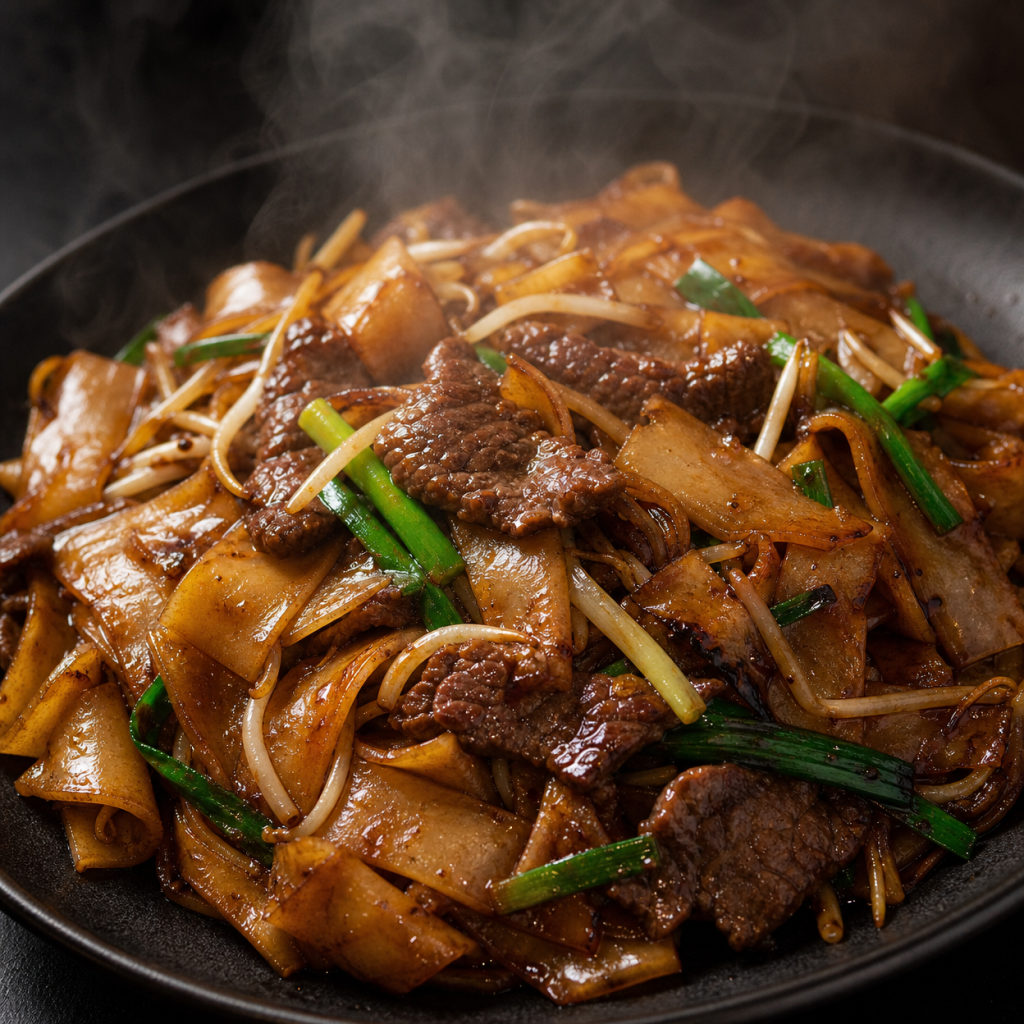
Beef Chow Fun, known in Cantonese as Gon Chao Ngau Ho (乾炒牛河), is a dry stir-fried noodle dish featuring wide, flat rice noodles called ho fun or shahe fen, tender sliced beef, fresh bean sprouts, and scallions. The dish is seasoned with a careful combination of dark and light soy sauce, oyster sauce, and sesame oil, and is distinguished from its “wet” counterpart (a similar dish prepared with a thickened, gravy-like sauce) by being cooked entirely dry — no additional liquid is added after the initial seasoning, and the dish relies entirely on the intense, focused heat of the wok and the exceptional skill of the chef for its distinctive character.
The name “dry-fried” refers to this absence of sauce; the noodles should be lightly coated but never swimming in liquid. Achieving this dry, charred, fragrant perfection is one of the greatest challenges in Cantonese cooking.
Wok Hei: The Soul of the Dish
Wok hei (鑊氣), literally “wok breath” or “wok energy,” is the smoky, slightly charred, incredibly aromatic flavor and aroma that results from stir-frying ingredients over extremely high heat in a well-seasoned, properly heated wok. It is arguably the most important, most prized concept in all of Cantonese stir-fry cooking and the quality by which Gon Chao Ngau Ho is most definitively and ruthlessly judged.
Achieving true wok hei requires several demanding conditions to be met simultaneously: the wok must be extremely, almost frighteningly hot — often exceeding 1,000 degrees Fahrenheit in professional kitchen settings with specialized high-output burners; the amount of ingredients in the wok must be carefully controlled so they do not lower the ambient temperature when added; and the chef must work quickly, confidently, and decisively, tossing and folding the ingredients rather than stirring, to expose them to the maximum, concentrated heat of the wok surface. This is not a technique that can be learned from a cookbook; it requires years of practice and an intuitive feel for the wok.
The science behind wok hei is fascinating. When droplets of oil and moisture from the ingredients come into contact with the superheated metal of the wok, they undergo a complex series of chemical reactions, including the Maillard reaction and caramelization, that produce hundreds of volatile aromatic compounds. These compounds are what give wok hei its distinctive, irresistible smoky fragrance. A dish with true wok hei smells as good as it tastes, and the aroma alone is enough to make your mouth water. Without wok hei, Beef Chow Fun is just noodles with beef — pleasant enough, but nothing special. With wok hei, it becomes something transcendent.
The Noodles: Ho Fun
The ho fun noodles used in Beef Chow Fun are wide, flat rice noodles made from rice flour and water. They are the same noodles used in the classic noodle soup dish of the same name, but for stir-frying, they require different handling. Fresh ho fun is significantly, dramatically superior to dried or packaged versions — fresh noodles are softer, more pliable, have a better, more pleasant texture when stir-fried, and are much less likely to break apart or become gummy. Fresh noodles also have a higher moisture content, which helps them steam slightly from the inside as they fry, contributing to the desired texture.
The noodles must be at room temperature before cooking; cold noodles straight from the refrigerator will lower the wok temperature dramatically when added and are much more likely to break apart or stick together in unappealing clumps. Separating the noodles gently by hand before cooking is absolutely essential — clumps of ho fun that go into the wok together will stick together permanently, resulting in a dense, unpleasant mass rather than individual, separated strands. The goal is for each noodle strand to be coated individually with the soy sauce seasoning and to carry the smoky char of wok hei from edge to edge.
The Beef Marinade: Velveting Explained
The beef used in Gon Chao Ngau Ho is typically flank steak, sirloin, or another relatively tender cut, sliced thinly against the grain to ensure tenderness. The marinade consists of light soy sauce, oyster sauce, Shaoxing wine, a small amount of baking soda, cornstarch, and a touch of sesame oil. The baking soda is absolutely crucial — a technique borrowed from Chinese restaurant kitchens called velveting. The baking soda raises the pH of the meat slightly, which breaks down some of the muscle fiber proteins and results in an extraordinarily tender, silky, almost luxurious texture after cooking.
Even relatively tough, inexpensive cuts of beef become tender, smooth, and juicy when properly treated with baking soda before stir-frying. The cornstarch in the marinade forms a thin, protective coating around each slice of beef, which seals in moisture and gives the exterior a pleasant, silky sheen. The marinated beef is then allowed to rest for at least 30 minutes, or up to several hours in the refrigerator, before cooking.
The Assembly: Speed Is Everything
Gon Chao Ngau Ho is a dish that absolutely punishes hesitation, indecision, or slowness. The entire cooking process, from the moment the first ingredient hits the hot wok to the moment the finished, aromatic dish is plated, should take no more than three to four minutes maximum. The beef is flash-fried first in a small amount of oil and removed while still slightly underdone, so it does not overcook during the final toss. The noodles go in next, spread across the wok surface in a thin, even layer to maximize their direct contact with the hot metal.
The seasoning sauces — a precise mixture of dark and light soy sauce, oyster sauce, and a touch of sugar — are added and the noodles are tossed quickly, vigorously to coat. The beef, bean sprouts, and scallions are returned to the wok for a final, brief toss before the dish is immediately, without delay, plated and served. Every second counts; a dish that sits in the wok for even thirty seconds too long will lose its wok hei and become soggy.
The Home Cook Challenge
Beef Chow Fun is notoriously, frustratingly difficult to replicate at home with authentic results because domestic stoves simply cannot generate the extreme, concentrated heat of commercial wok burners. The highest-output home burner produces roughly 20,000 BTU (British Thermal Units), while professional wok ranges operate at 100,000 to 200,000 BTU or even more. This five to tenfold difference in heat output means that home-cooked Gon Chao Ngau Ho will always have a different character from restaurant versions — less char, less smoke, less wok hei, and more steaming and less searing.
Despite this significant limitation, dedicated home cooks can still produce excellent, enjoyable results by using their largest, heaviest pan or wok, cooking in very small batches to maintain temperature, and cooking over the absolute highest heat setting their stove can achieve. The flavors will be slightly milder and the texture slightly less dramatic, but the dish will still be deeply satisfying, comforting, and delicious.
Why Beef Chow Fun Is a Benchmark Dish
In the Cantonese culinary world, the quality of a restaurant’s Gon Chao Ngau Ho is considered a reliable, accurate indicator of the overall quality of its kitchen and the skill of its chefs. If the noodles have proper wok hei, the beef is tender and well-seasoned, the bean sprouts are still crisp, and the dish is served immediately without sitting under a heat lamp, the kitchen is staffed by skilled, experienced cooks who take their craft seriously and care about quality.
If the noodles are greasy, clumpy, or broken, the beef is tough, chewy, or dry, or the dish lacks any smoky, fragrant character, those are warning signs about the kitchen’s standards, training, and attention to detail overall. This makes Beef Chow Fun one of the most important and revealing dishes to order when evaluating a new Chinese restaurant for the first time. It is the dish that separates the true professionals from the amateurs.
